

Take the First Step Toward Cybersecurity Excellence
Why Nexusguard?

Over 15 Years

Trusted by 100+

Protecting 50,000

40+



Learn More About Nexusguard Academy Courses
Let’s Start the Conversation
Why Nexusguard?
Over 15 Years
Trusted by 100+
Protecting 50,000
40+
Get in Touch with Our Experts
Let’s Start the Conversation
Why Nexusguard?
Over 15 Years
Trusted by 100+
Protecting 50,000
40+
Let’s Start the Conversation
Why Nexusguard?
Over 15 Years
Trusted by 100+
Protecting 50,000
40+
How Singapore's 99.95% availability rule reshapes your network architecture


Donny Chong
Nexusguard

Share to:
If you're scoping MAS TRM DDoS requirements for a Singapore-regulated financial institution in 2026, you're operating in a different regulatory environment than the one that existed eighteen months ago.
The revised MAS Technology Risk Management Guidelines came into force in May 2024. The Cybersecurity (Amendment) Act 2024 added a second layer in October 2025. Both fundamentally changed what evidence MAS expects you to produce when DDoS hits your customer-facing systems.
Most architecture documents still describe pre-2024 controls. Most vendor pitches still talk in pre-2024 language. This guide walks through what's actually changed, what MAS now requires from your DDoS posture, and how to map a managed DDoS service to each specific control before your next audit.
The Regulatory Shift Every Singapore CISO Is Aware Of
Singapore's financial sector has lived through a series of high-profile availability failures in recent years. None were identical in cause. All shared the same outcome: MAS scrutiny, public disclosure, and supervisory action that reshaped the evidence expectations every regulated institution now faces.
The pattern is consistent. When an outage becomes visible enough to generate public commentary, MAS responds by asking for the same set of controls regardless of root cause: failover evidence, BCP testing, third-party resilience review, and documented incident response.
The controls MAS has faulted across recent supervisory actions, failover evidence, BCP testing, and third-party resilience review are the same controls that determine DDoS audit outcomes. If you can't show MAS evidence of a tested failover under simulated availability stress, your DDoS posture isn't the only thing exposed.
That's why MAS TRM compliance suddenly matters. Not because the rules are new. Because the consequence of failing them is now visible.
Named DDoS Incidents Shaping Singapore's Regulatory Posture
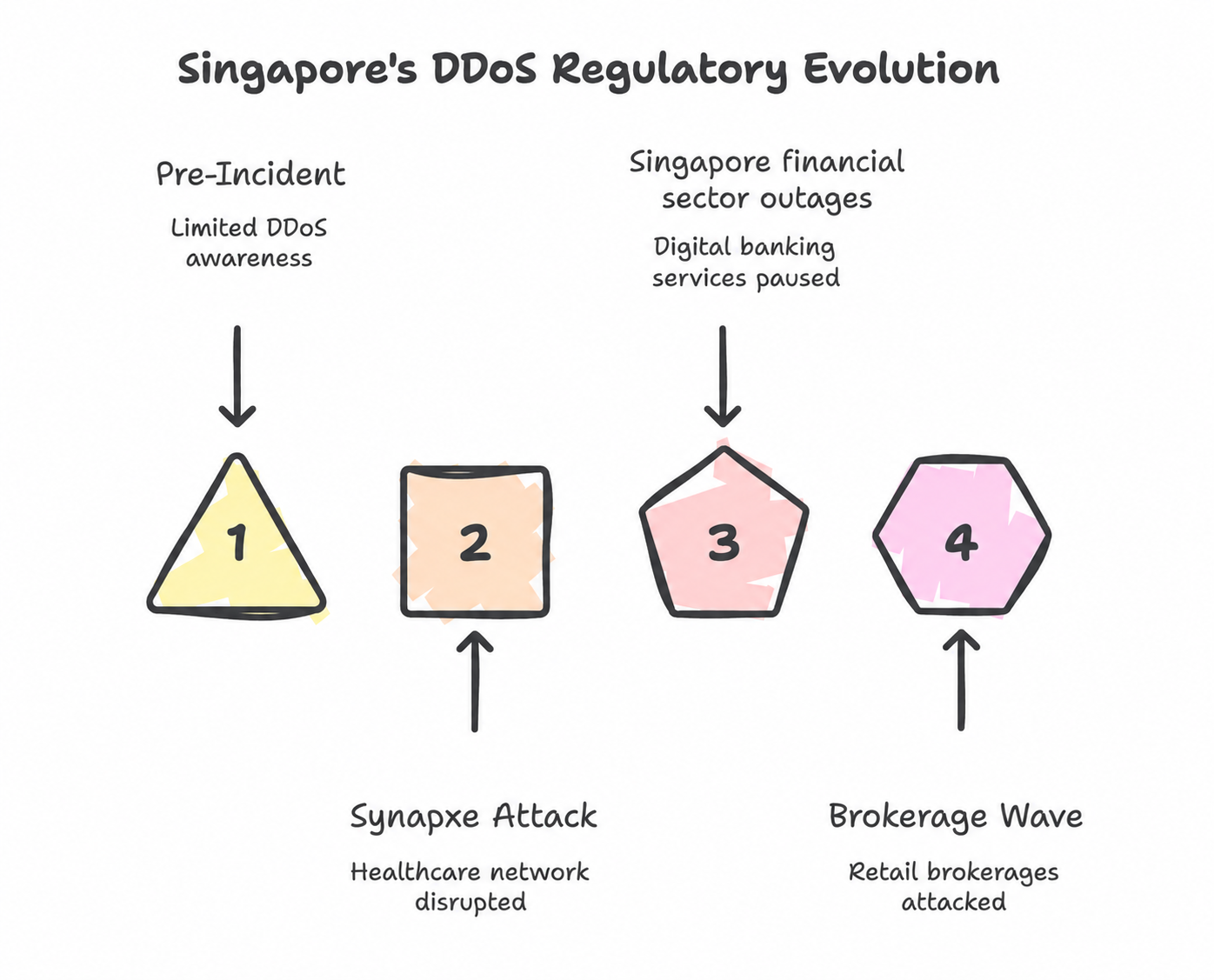
The Singapore financial sector pause is the most-cited recent incident, but it isn't the only event driving regulator attention. Three named DDoS-relevant cases matter for your MAS TRM gap analysis:
- Synapxe healthcare DDoS, 1 November 2023. Singapore's national public-healthcare network experienced a sustained DDoS attack that disrupted Internet connectivity at public hospitals and polyclinics. Email and web-based services were affected for several hours. The incident pre-dated the revised TRM Guidelines but heavily shaped the regulator's thinking on availability evidence requirements.
- Singapore financial sector outage, 14 October 2023. A 12-plus-hour outage that triggered the MAS pause in November 2023. Not DDoS-driven, but the root-cause analysis surfaced the same failover, BCP-testing, and resilience-evidence gaps DDoS audits now require.
- Singapore brokerage DDoS wave, 2020 (Phillip Securities, iFAST and others). A pattern of attacks on retail brokerages during a high-volume trading period exposed gaps in availability under simultaneous attack-plus-demand stress. Cited in MAS guidance as the reason availability requirements extend beyond pure cyber-event windows.
Singapore enterprises and CSPs serving regulated customers should be able to reference these cases by name in any architecture review.
What MAS TRM Actually Demands for DDoS
The revised MAS Notice on Technology Risk Management FAQs (February 2024) plus the revised TRM Guidelines (effective 10 May 2024) lay out specific, measurable obligations. The core regulatory instruments to know by name: MAS Notice 644 (Technology Risk Management) for banks, MAS Notice FSM-N30 for capital market institutions, and the TRM Guidelines for the broader supervised universe.
The Headline Numbers
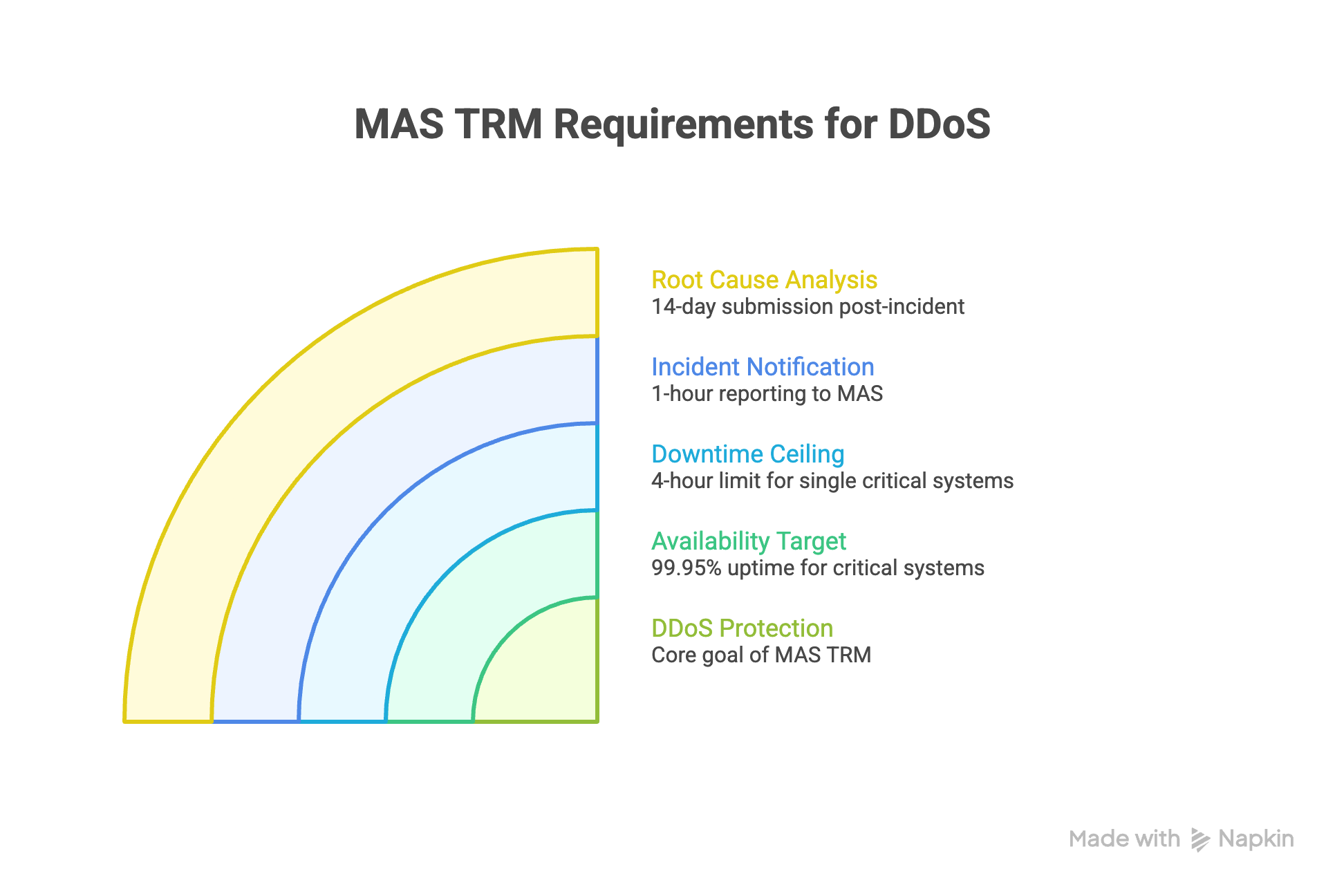
- Availability target: 99.95% availability for critical systems. That works out to no more than 4.38 hours of cumulative unscheduled downtime per year across all critical systems combined.
- Downtime ceiling: No more than 4 hours of unscheduled downtime in any rolling 12-month period for any single critical system. This is the harder constraint. A single 5-hour DDoS-driven outage breaches it for the next 12 months.
- Incident notification: 1-hour incident notification to MAS for relevant cyber incidents. DDoS attacks are explicitly enumerated as reportable. The clock starts when the institution becomes aware of the incident.
- Root cause analysis: 14-day root cause analysis submission post-incident. Has to identify root cause, remediation actions, and timeline.
What this actually means in operations: You need DDoS detection that triggers in under 60 seconds. SOC visibility that flags the incident inside the 1-hour window. Forensic logging that survives a 14-day reconstruction. Failover that doesn't add to your 4-hour rolling-12-month downtime budget.
A managed DDoS service that takes 90 seconds to detect and 5 minutes to mitigate is fine for SLA purposes.
It's not fine for MAS notification purposes. This is where hybrid architectures pull ahead of pure-cloud, on-prem inspection sees the attack before the cloud-edge logs do.
The Cybersecurity Amendment Act 2024 Layer
Singapore's Cybersecurity (Amendment) Act 2024 came into force on 31 October 2025. It's a separate regulatory layer from MAS TRM, but it stacks on top for any financial institution that's also classified as Critical Information Infrastructure.
The Act adds:
- 2-hour notification to CSA for incidents that disrupt essential services (vs MAS's 1-hour for cyber incidents)
- Supply-chain incident reporting, if your DDoS vendor experiences a disruption that affects your service, that's now in scope
- APT-suspected attack reporting, even without confirmed attribution
- A new Foundational Digital Infrastructure (FDI) category that brings cloud providers, data-centre operators, and managed-security providers under direct CSA regulation for the first time
That last point is the one most vendors haven't priced in yet. A cloud-only DDoS service serving a Singapore CII customer is now a regulated entity by CSA, with its own incident-reporting clock.
Why Most Cloud-Only Architectures Struggle Under MAS Scrutiny
Three structural problems make pure-cloud DDoS hard to defend in a MAS audit.
1. Data residency
MAS TRM is increasingly specific about where customer data can be processed and stored. A pure-cloud DDoS service that backhauls traffic to scrubbing centers in Frankfurt, Ashburn, or even Tokyo creates jurisdictional questions auditors now ask explicitly. Where does the customer traffic physically transit? Where are the logs stored?
2. Shared-tenant logging
Cloud DDoS providers run multi-tenant infrastructure. Producing tenant-isolated evidence for a MAS RCA, within 14 days, is harder than the marketing materials suggest.
3. The 1-hour clock vs the support-ticket clock
If your DDoS mitigation is triggered by an internal control on the cloud vendor's side, the moment you become 'aware' of the incident is when their portal flags it or their SOC calls you. Some vendors have 15-minute notification SLAs. Some have 60-minute. The MAS clock doesn't care about business hours.
The architecture that survives MAS scrutiny is hybrid. On-prem appliance in-network, vendor cloud for burst capacity, unified portal feeding your SOC inside the 1-hour window.
The Seven Controls Every MAS-Compliant Architecture Must Demonstrate
These are the controls that show up in MAS RFI responses, in iCAST-style simulations, and in board-level risk reviews.
- Always-on protection, not on-demand. MAS expects detection to happen continuously. On-demand scrubbing creates a window where the incident clock has already started before you've started mitigating.
- Multi-layer protection. Network-layer (L3/4 volumetric), application-layer (L7 / HTTPS Floods), and DNS-layer. MAS auditors increasingly ask about DNS specifically.
- In-region scrubbing. Customer traffic processed in Singapore or an explicitly approved jurisdiction. Vendor agreement specifies the scrubbing location per traffic class.
- Documented runbooks. Step-by-step mitigation procedures for the top 15 attack types. Reviewed annually. Tested in tabletop exercises.
- Tested failover with evidence. MAS expects evidence that your failover actually works, not just policy that says it should. Annual chaos-engineering exercises or BCP drills with output documentation.
- SOC visibility for the 1-hour clock. Logs from the DDoS service flow into your SIEM/SOAR in near-real-time. Your SOC sees the incident before the customer does.
- Vendor SLAs aligned to TRM uptime. The vendor's published SLA matches or exceeds 99.95%. Their downtime gets added to your downtime budget. Contractual remedies exist for breach.
If your current DDoS service can't produce evidence for all seven, you have an architecture gap, not just a procurement gap.
How Hybrid Architecture Maps to MAS TRM
This is the specific mapping that closes deals in Singapore BFSI procurement cycles.
RFP Language Template: What to Demand from Any DDoS Vendor
These are the specific contract terms a MAS-regulated FI should require in any DDoS RFP.
- Detection SLA: "Vendor must detect volumetric DDoS attacks within 60 seconds of attack onset."
- Mitigation SLA: "Vendor must initiate mitigation within 90 seconds of detection."
- Notification SLA: "Vendor must notify customer SOC within 15 minutes of any DDoS event regardless of size."
- Scrubbing location: "Customer traffic must be scrubbed in Singapore or approved jurisdiction. Vendor must provide network-flow attestation on request."
- Tenant isolation: "Vendor must produce per-customer forensic logs sufficient to support a MAS RCA within 14 days."
- Availability: "Vendor service availability must equal or exceed 99.95%. Service credits apply below this threshold."
- CSA reporting alignment: "Vendor must notify customer within 30 minutes of any incident affecting the customer's regulated systems, sufficient for the customer to meet 2-hour CSA notification under the Cybersecurity Act 2024."
- Right to audit: "Customer reserves the right to audit vendor's scrubbing operations once per year with reasonable notice."
If a vendor pushes back on any of these, the pushback is the answer. They can't meet MAS obligations.
Where Cloudflare, AWS Shield Advanced, and Akamai Prolexic Fall Short
The three hyperscaler-class DDoS products most commonly deployed at Singapore FIs each have specific gaps against revised MAS requirements:
- Cloudflare Magic Transit: Routes customer traffic to Cloudflare's global Anycast network. Singapore traffic typically lands at the SIN PoP, but the contract doesn't guarantee single-jurisdiction processing under attack conditions. Notification SLAs default to portal-based alerting, manual SOC-to-SOC reach requires Enterprise tier.
- AWS Shield Advanced: Protects AWS resources only. For an FI running hybrid, Shield is one piece of a multi-vendor stack and the MAS evidence chain has to span the gaps. The 15-minute Shield Response Team escalation requires Business or Enterprise support, adds ~$15K/month minimum.
- Akamai Prolexic: Has the strongest Singapore PoP footprint and an explicit 3-second mitigation SLA. The gap is on per-tenant forensic isolation for 14-day RCA, Prolexic's reporting is detailed but tenant-isolation depth varies by service tier. Confirm the SKU your contract includes.
None of these are wrong choices for the right institution. They are all easier to defend in an MAS audit when paired with an in-CSP-network on-prem appliance that anchors the data-residency story.
FAQ
Does MAS TRM apply to non-bank financial institutions?
Yes. MAS TRM applies to all MAS-regulated financial institutions, banks, insurers, capital market intermediaries, payment service providers, designated payment systems, e-money issuers. The availability and incident reporting requirements scale with institution size and criticality, but the framework applies broadly.
What about cloud DDoS vendors with a Singapore PoP, are they MAS-compliant?
Having a Singapore scrubbing PoP is necessary but not sufficient. The vendor also needs to demonstrate that customer traffic actually routes through that PoP, that logs are stored in Singapore, that tenant isolation supports per-customer RCAs, and that notification SLAs match the 1-hour clock. A PoP is infrastructure. Compliance is process.
How does the 1-hour clock work if the attack starts at 3am?
The clock starts at the moment the regulated institution becomes aware of the incident. Regulated FIs need 24/7 SOC operations that can confirm and report a DDoS incident regardless of time of day. Outsourcing the SOC to the vendor is acceptable, provided the vendor's notification SLA is fast enough.
Are we required to use a Singapore-incorporated DDoS vendor?
No. MAS TRM doesn't require Singapore incorporation. It requires demonstrable risk management, including vendor due diligence, contractual obligations, audit rights, and incident response evidence.
What happens if we breach the 4-hour downtime ceiling?
A breach triggers an MAS supervisory response. Initial response is typically a request for explanation and a remediation plan. Repeat breaches can escalate to formal supervisory action, including mandated independent reviews (as Singapore financial sector experienced in 2023).
What's the difference between MAS TRM and the Cybersecurity Amendment Act 2024?
MAS TRM is sector-specific (financial services). The Cybersecurity Act is cross-sector and applies to Critical Information Infrastructure across multiple industries. Many MAS-regulated FIs are also CII designees, in which case both frameworks apply.
How does this affect my existing Cloudflare or AWS Shield contract?
Most cloud-only DDoS contracts predate the revised MAS TRM and the Cybersecurity Act 2024. Most institutions will need a contract amendment, or a parallel hybrid arrangement for MAS-regulated workloads, to bring the architecture into compliance.
What to Do This Week
If you're a Singapore-regulated FI scoping DDoS compliance, the next concrete step is a gap analysis between your current vendor's published SLAs and the 7 controls above. Half the time the gap is closeable through contract amendment. Half the time it requires an architecture change.
If you're a CSP selling DDoS protection into the Singapore BFSI market, build the architecture mapping document referenced above and put it in front of every BFSI prospect in your pipeline.
For a conversation about how Nexusguard's hybrid architecture maps to MAS TRM controls, schedule a 30-minute review with our APAC team: https://www.nexusguard.com/contact-us
Looking for Simpler DDoS Protection?


Related Articles

Unmasking Deception: Malware Disguised as Meta Verification Tool

Preparing for the Post-Quantum Era: Nexusguard’s Approach to PQC Readiness
